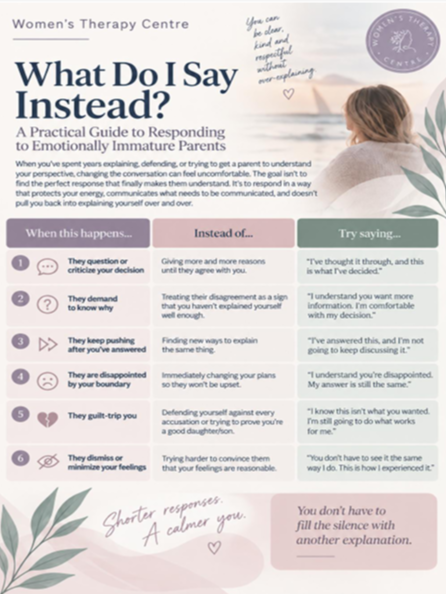
Resource
How to Respond to Emotionally Immature Parents | Free Guide
Not sure what to say to an emotionally immature parent? Download practical scripts for setting boundaries and stopping over-explaining.
View Resource
When you grew up knowing what kind of night it was going to be by how loudly a cupboard closed.

Maybe your childhood looked pretty normal from the outside. Your parents may have loved you, worked hard, provided for you, and done many things well. You might even feel guilty reading a page like this because other people had it much worse.
And still, there may not have been much room for your feelings, needs, opinions, or version of events.
Perhaps you became the responsible one, the peacemaker, the easy child, or the one who could read a room in seconds. You learned when to bring something up, when to let it go, and how to tell from the sound of a voice whether this was a good time to need something.
Now you're an adult. But you still over-explain perfectly reasonable decisions, feel guilty when someone is disappointed in you, question boundaries you know make sense, or find that one disapproving text from a parent can make your fully grown nervous system feel about twelve years old.
At Women's Therapy Centre, therapy for adult children of emotionally immature parents isn't about building a case against your parents. It's about understanding what you learned to do in order to stay connected—and whether you still want to live by those rules now.
Emotionally immature parenting doesn't mean having imperfect parents. All parents get things wrong. Every parent does. It's whether there was room for your experience when they did.
It describes recurring relationship patterns where a parent's own emotions, needs, defensiveness or perspective leave limited room for the child's emotional experience.
Maybe expressing hurt was met with “After everything I've done for you.” Maybe disagreement became disrespect. Maybe a parent's bad mood changed the atmosphere of the entire house. Or perhaps nothing particularly dramatic happened—you simply learned that certain feelings were easier to have privately.
Children notice these things. And because children depend on their caregivers, they usually don't conclude, My parent has difficulty tolerating emotions.
They are much more likely to learn: Maybe I shouldn't need so much. Maybe I should keep the peace. Maybe it's easier if I handle this myself.
One of the hardest parts is that emotionally immature parents can also have wonderful qualities. Maybe they showed up for every soccer game, worked incredibly hard for your family, or would drop everything if you needed practical help—and still weren't the person you could safely tell, “You hurt me.”
Both can be true.
As an adult, you may notice that you:
Sometimes these patterns don't look like problems at all.
They look like being thoughtful. Independent. Easygoing. Helpful. Really good at taking care of everyone else. And that can be exactly why they're so hard to recognize. They are also exhausting.
Children are remarkably good at adapting to the relationships they grow up in.
If staying connected meant keeping the peace, being independent, achieving, staying quiet, anticipating someone's mood or not asking for too much, those responses may have made perfect sense.
The problem is that nobody hands you a memo at eighteen saying, You can stop doing that now. So the pattern comes with you.
You may intellectually know you're allowed to say no and still feel compelled to provide three paragraphs explaining why. You may know someone else's disappointment isn't dangerous and still feel an urgent need to fix it. You may be completely capable of making your own decisions—and suddenly find yourself questioning one because your parent doesn't approve.
That's why insight alone doesn't always change these patterns. Your adult mind may know you're allowed to disappoint someone while another part of you still experiences their disappointment as a threat to connection.
The strategy that once helped you stay close to the people you needed can eventually become the thing that makes it difficult to know where other people's needs end and yours begin.
Therapy isn't about teaching you to blame your parents, confront them, cut them off, or finally deliver the perfect boundary speech.
And it isn't about telling you what your relationship with them should look like.
It's about getting curious about what happens inside you.
Why does saying no produce so much guilt? Why does someone's disappointment immediately feel like something you need to fix? Why can you trust yourself in a hundred other areas of your life and suddenly question everything after one conversation with your mother or father?
The work might involve setting a boundary without writing a six-paragraph defence of it. Letting someone be disappointed without immediately changing your decision. Recognizing what you actually want before automatically considering everyone else's needs. Trusting your own perception. Or grieving the relationship you kept hoping might become possible someday.
Where appropriate, therapy may incorporate attachment-focused work, parts-informed therapy, nervous-system regulation and EMDR when a pattern makes complete sense intellectually but still feels difficult to shift emotionally.
The goal isn't to become unaffected by your family.
It's to stop needing everyone else to be okay before you're allowed to be okay too.
Sheena works with women exploring the lasting effects of emotionally immature parenting, attachment wounds and difficult family and relationship patterns. She has completed specialized training in Dr. Lindsay Gibson's Adult Children of Emotionally Immature Parents (ACEIP) model and integrates this understanding with attachment-focused, parts-informed, somatic and EMDR approaches.
Her work often begins where understanding alone leaves off. You may already know why you people-please, over-explain or feel responsible for everyone else's emotions—and still find yourself doing it. Therapy can help you begin experiencing relationships differently: trusting yourself, tolerating other people's disappointment, setting boundaries with less guilt, and building connection that doesn't require abandoning your own needs.
No. Therapy isn't a training ground for a confrontation you don't want to have. Your parents don't need to participate, agree with your perspective, or even know you're in therapy.
The focus can be entirely on you—understanding what happens in these relationships, what you need, what you want to do differently, and what kind of relationship feels realistic for you.
Absolutely. This is often one of the most complicated parts.
Your parent may have loved you deeply, sacrificed for you, made you laugh, supported you in important ways—and still have been unable to meet some of your emotional needs.
Understanding what was missing doesn't require rewriting your entire childhood as bad. You can be grateful for what you received and grieve what you didn't.
Both belong in the story.
It can help you show up differently in the relationship. You may become clearer about your boundaries, less reactive to familiar dynamics, more confident in your own perception, and more intentional about what you will and won't participate in.
What therapy can't do is make another person become more emotionally available, understand your perspective, or respect a boundary.
Sometimes improving a relationship means becoming closer. Sometimes it means changing your expectations. Sometimes it means more distance. Therapy isn't there to decide which of those is right for you—it can help you become clearer about what is.
You don't have to decide your childhood was terrible to acknowledge that some of what you learned there may be making adulthood harder.
And you don't have to stop loving your family to start making more room for yourself.
Sheena offers virtual therapy for adult children of emotionally immature parents. Book a free consultation to see if working together feels like the right fit.